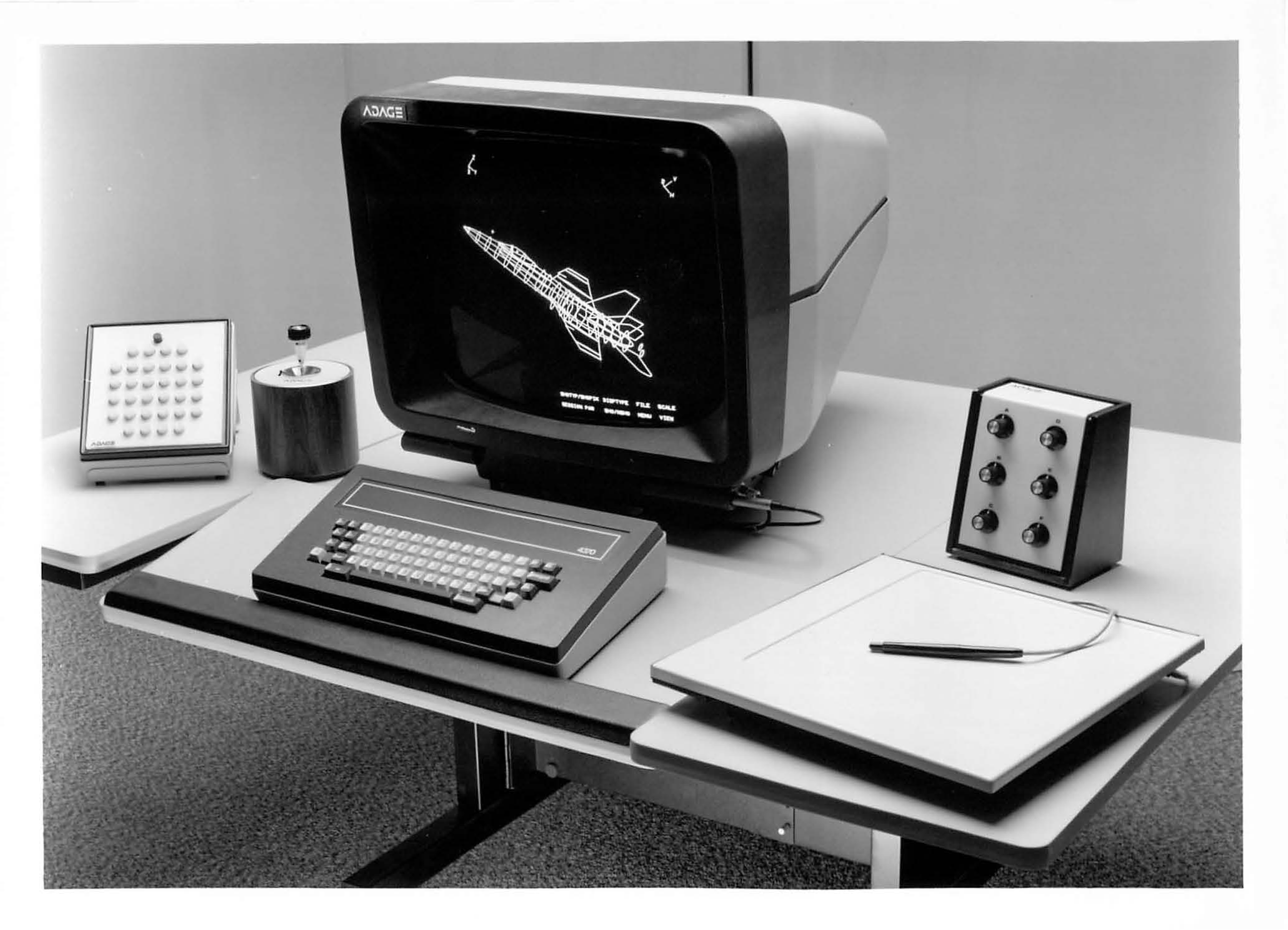
In the 80's, Adage created 3D vector terminals that were ahead of their time. They were quite powerful and included hardware rotation that could be manipulated with a joystick, 3D trackball, or analog dials. The versions that we worked with supported 4 colors and let you draw at a resolution of 4096x4096. At that time, home computers were 320x240 or 640x480. Their main limitation was that they worked by manipulating a beam that excited the phosphorus, and if you took too much time to draw the line would start to fade and that would cause flicker. Depending on what you were drawing, that could make using the terminal difficult. We spent a lot of time trying to optimize the display list. The display list is the list of coordinates that the monitor reads telling it what to draw. It also told it when to turn on and off the beam.
Optimizing the display list meant reducing the number of vectors, minimizing how often you had to turn off
the beam, and keeping the vectors close together. At the same time, you didn't want to compromise what
the image looked like.
Picture of terminal similar to what we used: