About this translation
Original publication: Happy Computer, September 1986, in the “Aktuelles” (“News”) section. The article is signed “hb.”
German title: “Computer-Schmiede »Atari-Lab«”. Read the German original at the Computer Magazine Archive →
This full English translation was prepared for this site from the German text supplied by Bruce. The photographs come from the archived article; their original captions are translated below. The building photograph has an editorial caption. Obvious transcription and line-break artifacts have been normalized. The introduction and related-reading links are editorial additions.
The translation preserves the article’s contemporary claims, technical explanations, and predictions. Descriptions of prototypes, specifications, prices, and expected releases reflect what was reported in 1986; they do not establish what eventually shipped. For historical context, see Creating the Atari ST.
Inside the Atari Lab
News
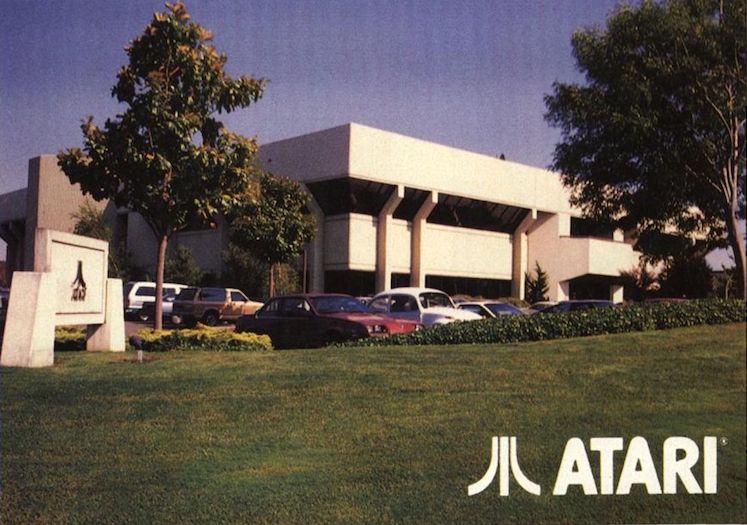
New computers, superfast processors, incredible color graphics: we visited Atari’s engineering laboratories. In this Californian computer forge, the weapons for tomorrow’s market battle are already in the fire.
The sun beats down mercilessly; scorching heat hangs over the road. The air shimmers, forming mirror-like pools on the asphalt. The highway runs straight as an arrow through the desert. Two wild-looking fellows on heavy Harley-Davidsons overtake my car. On the blue sign above the highway, “Sunnyvale” appears in large letters. No, this is no Easy Rider dream. I really am in California, on my way to Atari.
Atari’s headquarters is on Borregas Avenue in a new industrial area of Sunnyvale. Here, Atari’s top boss, Jack Tramiel, makes decisions that substantially influence the computer market and that his competitors have come to fear. And here, Shiraz Shivji and his staff are already developing future versions of the ST. Jim Tittsler, for example, is working on an operating system for the “Blitter” coprocessor and high-resolution color graphics.
The “Atari Lab” headquarters resembles a control tower. The low building widens at its upper third. This is not for show, but an architectural trick to keep the sun from shining into the windows. Temperatures above 30 degrees Celsius are normal all year round. Only in winter does it sometimes rain; otherwise, the climate in this sunny land is really much too beautiful for work.
Atari’s chief developer, Shiraz Shivji, is expecting me at ten o’clock. The home-computer industry owes its biggest bestseller, the Commodore 64, to his abilities. About a year ago, he moved to Atari and developed the 16-bit price-breaker, the Atari ST. But the ST, Shivji says, is only the beginning of a whole range of computers using 16-bit technology.
At the gates of the technology temple
Shiraz and I already know each other from numerous trade shows, so I know who will be waiting for me. Shortly before ten, I turn into Borregas Avenue and park in front of the impressive building. A young woman and a uniformed, armed guard are sitting in the reception area. After handing over my business card, I receive a visitor’s pass. Shiraz comes to collect me a few minutes later. No visitor may enter Atari Lab without an Atari employee as an escort.
The security rules are very strict. Many competitors would dearly love to know what new products the development crew is working on.
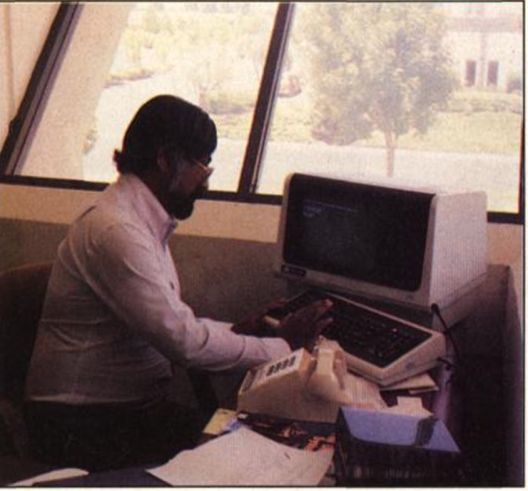
Shiraz greets me warmly. After the obligatory brief small talk, without which nothing happens in California, we go to his office upstairs. It is not large. The front of the room is taken up by a round table with room for only two chairs. The table is piled with circuit diagrams. Farther back stands his desk, next to a terminal for one of the three VAX 11/780 computers. These computers help him and his staff with development work.
One of these VAX machines has been simulating the Blitter since October 1985. Only when a chip’s circuitry works perfectly in simulation do the “real” test versions follow.
Naturally, I ask Shiraz about the other ST computers. He has told me a little about them at trade shows, and the rumor mill has added its own ingredients. Now I hope to learn firsthand what Atari is planning.
Shiraz smiles at my question. He has surely been asked it many times. Unfortunately, he cannot always provide as much information as he would like. “Yes, we are working on many new things. No company can rest on its laurels. We have only just begun to develop a new generation of computers. The ST is only the beginning of a series of further computers. I’ll be happy to show you something about that later.” I am eager to see it, but there are more questions first.
“When is the Blitter coming? Some people claim it doesn’t exist.” He laughs, with a mischievous gleam in his eyes: “Come along.” We go into the adjoining office. I am introduced to Duck Renn, Atari’s chip specialist. GLUE and the Shifter are his work. They have already proved themselves in more than 200,000 STs sold.
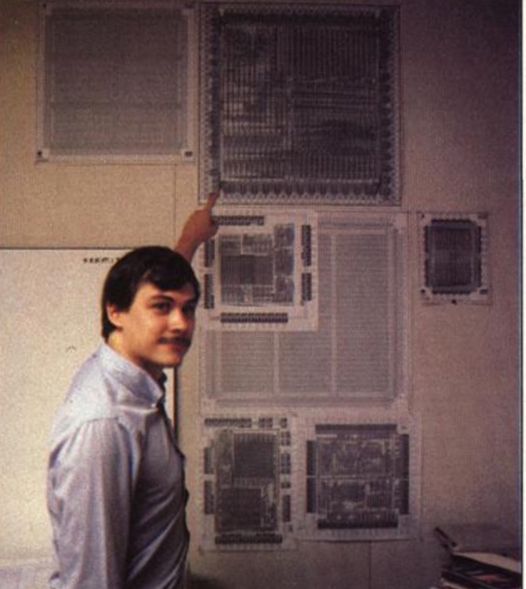
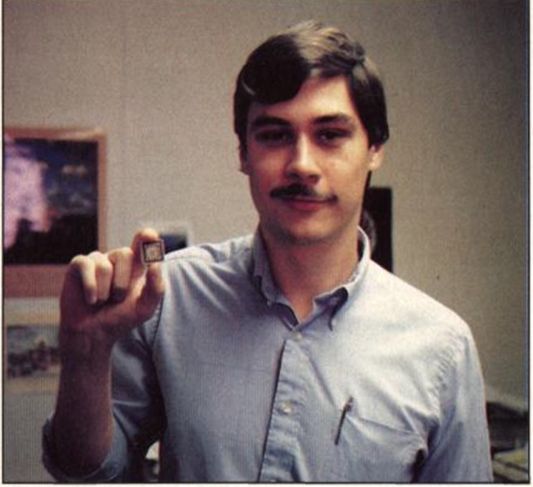
He shows me test samples of the Blitter. It is the same size as the other custom chips. The closely guarded layout of this fast graphics processor hangs on the wall: a tangle of countless fine lines on a large sheet of paper. The small chip combines the switching functions of more than 20,000 transistors. Yet Duck Renn knows every one of these lines by heart. This speedy helper is supposed to make graphics operations run up to twenty times faster.
The principle is simple. A graphics processor of this kind has a large number of instructions for manipulating bits. That is what distinguishes it from a CPU such as the 68000. The 68000 CPU is also very fast, but its instruction set is byte-oriented. If, for example, you want to manipulate an area of memory bit by bit, considerably more work is needed than for byte-wise operations. And since a point on the screen always represents a bit, a graphics processor is a bit-oriented processor.
“Are there working versions of the graphics card yet?” I ask. Yes, there are. Shiraz takes me through several doors protected by alarm systems. Only the head of development may show me projects at such an early stage. The last door is metal. Here Atari shields its most secret developments from unauthorized eyes. My pulse begins to quicken. What will I find behind it?
In one corner lies an ST circuit board, with another board of the same size behind it. An enormous number of small ICs sit on the second board, connected by individual wires. Circles, rectangles, and lines race across the monitor, all at a resolution no Atari ST can produce: 640 × 480 pixels in sixteen colors! But the first board is from an ST; I recognize it with certainty. The second is the experimental version of the high-resolution color card.
It works — and how! The graphics are impressively fast. Images from the experimental setup flicker on a JVC monitor. Atari has something in store here too. Even Atari’s excellent monochrome monitor cannot keep up with the new graphics card’s resolution. In monochrome it delivers an incredible 1280 × 960 pixels, enough even for professional CAD applications.
Top secret
To reduce the ST’s price still further, Shiraz’s staff are working to reduce the number of components. In future, the MMU and GLUE will sit directly on the circuit board in flat-pack packages. Flat-packs are only one-third of the previous height and need no sockets. Initial test versions of these exist too.
Unfortunately, I am not allowed to photograph these very latest projects. As we entered the “top secret” room, Shiraz insisted: “No pictures, please.” There are changes to the ROMs too. Where six chips have been used until now, soon only two will sit on the board. Atari is using 1-megabyte ROM chips. This leaves room for the Blitter. In future ST generations it will be part of the motherboard, also using space-saving and cost-cutting flat-pack packaging.
A CD-ROM drive stands on a workbench. It works and, technically speaking, could go on sale immediately. But Atari has not yet found a manufacturer willing to meet its price demands. Jack Tramiel’s arguments are hard to dismiss. A CD-ROM drive for computers needs only a few additional components compared with a CD player. Its price should therefore not be substantially higher than a CD player’s.
Back in his office, Shiraz tells me that the next ST will have not only higher resolution but more memory. Test machines are already running with 4 megabytes. The current ST can already address that much with its MMU, or Memory Management Unit, without additions.
The new Super-ST
To make better use of all that memory, for example through multitasking, Atari is turning to new memory-management chips from Motorola. The further development of the MMU is called the PMMU. Its main distinction from the MMU is virtual-memory management. A computer with multitasking capabilities needs virtual-memory management. Hardware support for such capabilities takes work off the operating system’s shoulders.
But will it also get a more powerful CPU? Yes: the heart of the new ST is a Motorola 68020, a genuine 32-bit processor running at 12.5 MHz. This processor uses what is called a cache, with a capacity of 256 bytes. The CPU loads a 256-byte section of the program being executed from RAM into this cache. If the program runs in a loop within that area, no access to external chips is needed. The time saving is enormous.
To make the STs still more powerful, the 68020 also gets a strong helper: the 68881 arithmetic processor. This processor works with eight 80-bit registers, which is especially important for CAD tasks.
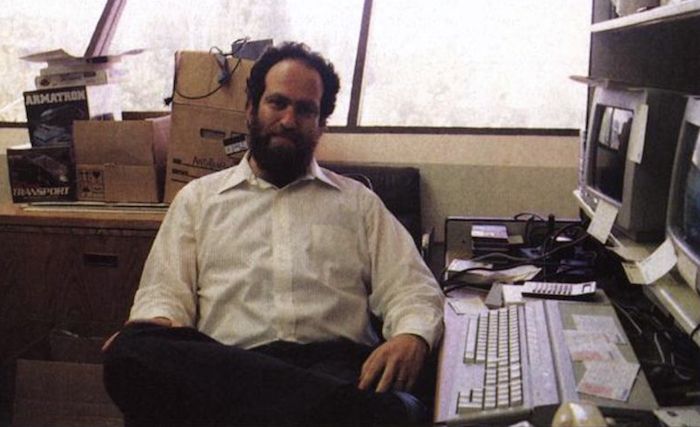
What could come after such a wonder-ST with a 68020, 68881, graphics card, and Blitter? For people like us, that is already almost science fiction. Computers with these specifications currently occupy dizzying price heights. But Atari has to keep proving its slogan, “Power without the Price.” The new ST is also supposed to cost only 3,500 marks.
It is difficult to imagine how development could continue. Which processor comes next? Shiraz smiles knowingly as he says: “The 68030.” I hesitate: “The 68030? I don’t know that processor.” “The 68030 combines the 68020 with part of the PMMU. With a 20 MHz clock speed and 32-bit architecture, it is twice as fast as a VAX 11/780.”
It dawns on me: the Cray simulator for everyone is getting closer. But we will have to wait until at least 1987; Motorola will not deliver its new super-CPU in larger quantities before then.
But back to the machine that will be available soon. It already makes possible applications that previously required elaborate hardware. The larger memory, for example, allows direct control of a laser printer. With 2 megabytes of RAM, a controller between computer and printer can be dispensed with. With that much memory, the ST can drive a laser printer directly. Concrete plans already exist.
Jack Tramiel wants to put an ST with 2 megabytes of RAM, a floppy drive, a monochrome monitor, and a laser printer on the market for just under 6,000 marks. An incredible offer, but tearing down price barriers is Atari’s much-feared strength.
More aces up the sleeve
So Atari has more aces up its sleeve in hardware, but what about software? BASIC has unfortunately been a disappointment so far. When can we expect a version without bugs? Shiraz does not feel sufficiently qualified to answer this question. He therefore introduces me to Leonard Tramiel, one of Jack Tramiel’s sons. His answer is promising:
“The new BASIC is not only bug-free; some new commands have been added too. With the commands ‘Get_Shape’ and ‘Show_Shape’ you can manipulate sprites and easily create fill patterns for areas yourself. With PEEK and POKE, you no longer need commands to define the access sizes of byte, word, and longword. Integer precision has been doubled. It is now 32 bits.”
Processing speed has increased, but unfortunately only minimally. Despite the improvements, Atari BASIC is therefore still of limited use for larger applications. But there are quite a number of other languages.
At almost every trade show Atari attended, new rumors about BASIC appeared. At CeBIT, it was said that Atari would supply GFA’s interpreter in future. A week later, Memsoft in Paris claimed it had signed a contract with Atari for its BASIC interpreter. Leonard Tramiel refuted all these rumors. Both sides are honoring the contract with Metacomco. Apart from a few errors, BASIC is finished. But we cannot expect the new interpreter to be delivered until Atari is convinced it is free of bugs. Testing is in full swing.
Sig Hartmann, president of software, is responsible for application software. The latest software products come to him. Through his close contacts with software houses and customers, he knows which programs have the best sales prospects. Asked where Atari sees major markets, he answers without hesitation:
“In universities and businesses. They often have mainframes with many terminals connected to them. Now, instead of a ‘dumb’ terminal, you can connect an ‘intelligent’ ST. A complete ST system costs less than a terminal and can be used as an independent system. Its uses are more varied. Quite apart from that, if the mainframe has a problem, conventional terminals would be fully affected, whereas you can carry on working with the STs.”
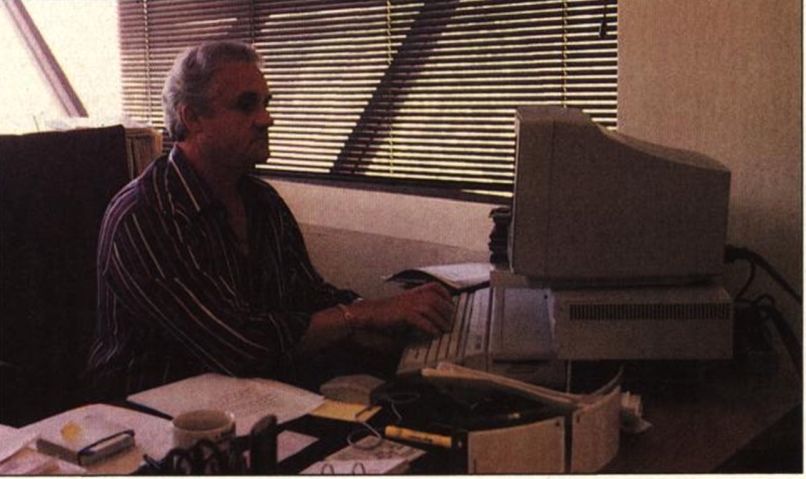
For this, Atari needs terminal emulators. It already has a considerable number in its software catalog. Atari also wants to offer a whole range of operating systems. Richard Frick, a member of Sig Hartmann’s staff, is currently adapting the British operating system BOS to the ST. The more operating systems that run on a computer, the wider its range of applications.
Hartmann clearly identifies Unix as the system with the brightest future. It is the most powerful, and as demands continue to grow, Unix will prevail. That is why the new STs run not only TOS but Unix V as well.
Superior to the IBM PC?
The ST has established itself as a home computer, but in offices its competition — IBM and compatibles — is very strong. Perhaps too strong?
“No, we have a good machine that is far superior to the IBM PC and much better priced. The reason we have not yet gained a foothold there is software, not hardware. A home-computer user primarily buys a computer, meaning the hardware; a businessman buys a solution to a problem, meaning the software.”
I press the point: “Then why doesn’t Atari offer solutions to problems yet?”
“Because Atari can provide such solutions only in part. Software alone is not enough. There are already some quite good business programs, but that is only part of the solution. The businessman wants a nearby dealer from whom to buy the hardware and software, with a knowledgeable person immediately available when questions arise. So we need more local specialist dealers.
“Only then can we enter this market. It is a slow process. Specialist dealers first have to be convinced that they are selling a quality product with the ST. Anyone using an ST for bookkeeping must be sure everything works. It does, but the dealers also have to be convinced of that. Increasingly, they are. We have proved that we are not a flash in the pan.”
And Shiraz Shivji and his staff, with their excellent hardware, are making sure Atari will not be a flash in the pan in future either. It is a pleasure to see the relaxed atmosphere in which groundbreaking developments emerge here. Everyone is informal, everyone uses first names, and nobody wears a tie.
Over lunch with Shiraz and his staff in a Chinese restaurant, a legend unexpectedly comes to life. “I ate here yesterday too.” “Oh yes? With whom?” “With Steven Jobs.” Since Steven Jobs left Apple and founded his own company, he has been looking for good people — and Shiraz’s staff are among the best. Suddenly I realize: Silicon Valley is still a twentieth-century gold-rush town. (hb)
Original and related reading
All six photographs are from Happy Computer’s September 1986 article, preserved by the Computer Magazine Archive. Read the German original and view its photographs →
Read the companion English translation, Shiraz Shivji: Achieving So Much with So Little, or return to Shivji’s career and the creation of the Atari ST.