A new family built on an established computer
The 65XE and 130XE were introduced in 1985, after Jack Tramiel’s acquisition of Atari’s consumer business in July 1984. They retained the 8-bit software environment while the new company also developed the 68000-based ST. The two families served different purposes: the XE extended an existing platform; the ST required a new software ecosystem.
The grey XE enclosure made the older architecture look at home beside the ST, but it did not turn it into a reduced ST. The XE still used the 6502-family CPU, ANTIC, GTIA, POKEY, and Atari’s established ROM software. The local Mapping the Atari and XL OS addendum provide the foundation for understanding the inherited system.
Engineering work did not stop at the takeover
An Atari engineering report dated August 13, 1984 identifies Phil Suen as the contact for XL-family engineering and Shiraz Shivji for the 68000 family. This is direct evidence of parallel engineering responsibilities during the transition, rather than a retrospective assumption that all resources immediately moved to the ST. [1]
Related memos from David Sovey and Peter Ateshian concern a proposed integrated device called MUFFY. An August 10 schedule specifies prototype work using an 800XL with 128K of memory. These are valuable records of cost-reduction and memory-development work in the period. They do not establish that MUFFY, as proposed, was the chip used in the finished 130XE; a prototype schedule must not be substituted for a production schematic. [2]
That distinction is important to the XE story. Integration projects, inherited XL work, and the finished retail machine overlap, but are not identical. The released computer’s behavior is best checked against the published XE specifications and observed programming interface, while the memos explain what engineers were attempting under the new organization.
The 65XE and 130XE
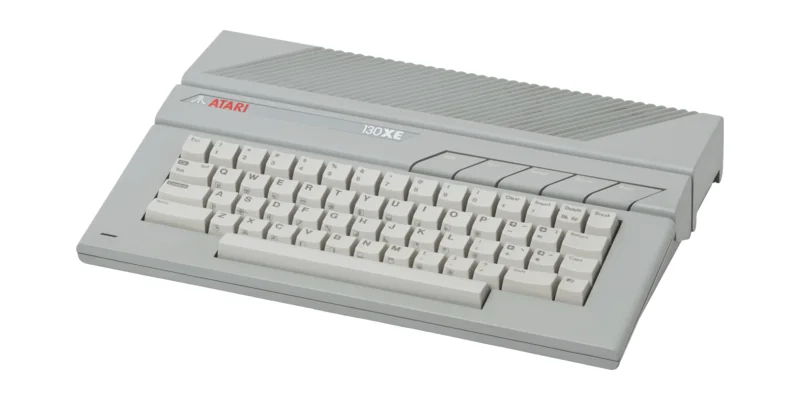

| Model | Memory | Place in the family |
|---|---|---|
| 65XE | 64K | The main continuation of the 800XL configuration in a new enclosure. Expansion connector arrangements vary with board and market. |
| 130XE | 128K | Additional banked RAM and the Enhanced Cartridge Interface alongside the cartridge connection. |
| 800XE | 64K | A later regional XE model carrying the familiar “800” name; it is not an Atari 800 in the original modular enclosure. |
| XE Game System | 64K | A game-oriented package with a detachable keyboard, retaining the underlying 8-bit computer platform. |
For the 130XE’s published memory and interface details, see Atari’s specifications as reported by ANTIC. For the later machines, the 1987 CES report and the model documentation linked below distinguish announced capabilities from the original 1985 configuration. [3] [6]
How the 130XE used 128K
The processor’s 16-bit address bus provides 65,536 byte addresses. The 130XE therefore cannot
expose all of its RAM as one continuous 128K address range. Its added 64K is divided into four 16K
banks that can appear in the window from $4000 to $7FFF. Control bits
select the bank and whether the CPU or ANTIC sees extended memory. This is a property of this CPU
and memory design, not a rule that all “8-bit” processors are inherently limited in the same way.
[4]
Separate CPU and ANTIC access creates useful possibilities: software can work on one area while display data comes from another. It also means that an application must deliberately support the banked arrangement. An ordinary BASIC program does not automatically receive twice as much contiguous workspace merely because the case says 130XE.
DOS 2.5 gave owners an immediate use for that memory through a RAM disk. Files could be accessed in memory rather than repeatedly moving the physical floppy disk. That made the additional capacity useful even to software that was not itself written to manage banks. The tradeoff is volatility: the RAM disk disappears when power is removed. Contemporary testing of the 130XE and DOS 2.5 explains both the practical benefit and the close relationship to the 800XL. [5]
The expansion interface changed too. The 130XE’s Enhanced Cartridge Interface works in combination with the cartridge connector to expose additional bus signals. It is related in purpose to the XL PBI, but has a different physical arrangement. Treating “PBI” and “ECI” as interchangeable connector names can lead to misleading descriptions of hardware compatibility. [7]
People and the surviving record
Phil Suen, David Sovey, and Peter Ateshian
The 1984 engineering report and signed memos place these people directly in the surviving development record. Suen appears as the responsible engineering contact; Sovey and Ateshian report on the integration project and its schedule. The documents reveal concrete engineering concerns—simulation, test equipment, pin counts, vendor schedules, and prototype debugging—without requiring an invented oral-history narrative. [1] [2]
Ira Velinsky and the physical design
The compiled Atari designer index credits Velinsky with the XE enclosures. It also identifies Vincent H. Wu as project manager in the late-XL/XE group, Richard Pasco for FREDDIE logic, John Skruch for product management, and José Valdes for the later XEGS/800XE hardware. These attributions are presented as a secondary credit record; the original memos above provide narrower, directly documented evidence. [8]
John Skruch and the game-system transition
The 1987 CES report names Skruch in connection with XE software and cartridge capacity. That places him in the public explanation of the later game-system strategy. It does not imply that he personally designed every board, wrote the original OS, or authored the repackaged games. [6]
The sources linked here do not provide a complete set of interviews with the XE engineering team. Where a person is known from a memo or compiled credit list, that source type is stated explicitly. The strongest firsthand material in this section is the contemporary engineering paperwork.
The 800XE and XE Game System
The later 800XE continued the conventional keyboard-computer form in selected markets. The XE Game System approached a different audience: a buyer could begin with games and attach the keyboard for computer use. The architecture made this repackaging possible because the system could draw on an existing library of 8-bit software and compatible peripherals.
At the 1987 Summer CES, contemporary reporting described a package with a light gun, joystick, and games, including built-in Missile Command. It also discussed plans to bring familiar disk and arcade titles to cartridges. Those announced plans belong to the history of Atari’s marketing and software program; they should not automatically be treated as a list of products delivered exactly as promised. [6]
The XE’s achievement was continuity. Existing skills, programs, and peripherals still had value. Its limitation was the other side of that choice: extra RAM and a new enclosure did not provide the ST’s larger address space, 68000 instruction set, or GEM environment. The two product families could coexist, but software generally had to be rewritten for the new one.
Chronology
- July 1984: Atari’s consumer business changes ownership.
- August 1984: Reports and memos document continued XL-family work, integration proposals, and a 128K prototype configuration.
- 1985: The 65XE and 130XE introduce the new family; contemporary articles explain the memory arrangement and DOS 2.5.
- 1987: The XE Game System appears at CES; the 800XE also belongs to the later phase of the family.
- Thereafter: The inherited 8-bit architecture remains useful to users and developers even as Atari’s main new-computer development follows the ST line.
Original documents, articles, and further reading
- Atari Engineering Weekly Report, August 13, 1984 — PDF. Original internal report; page 7 identifies the engineering contacts.
- Sovey and Ateshian: MUFFY status, August 3, 1984 — PDF and MUFFY schedule, August 10 — PDF. Project evidence, not a specification of the production 130XE.
- Jack Powell: “130XE: How Atari’s New 8-Bit Does It”, ANTIC, July 1985. Contemporary publication of Atari’s technical specifications.
- “RAM Banks on the 130XE”, ANTIC. Contemporary programming explanation of the extended-memory window.
- “Using the Atari 130XE and DOS 2.5”, COMPUTE!, October 1985. Hands-on coverage of the computer and RAM disk.
- Z*Magazine, June 15, 1987: CES and the XE Game System. Contemporary reporting including John Skruch’s comments.
- Mapping the Atari: the XL/XE parallel bus, by Ian Chadwick. Compare with the local PDF.
- Atari 8-bit FAQ: designer credits. Secondary roster distinguishing the late XL/XE and XEGS/800XE groups.