From the VCS to a home computer
The Atari 800 grew out of work on what should follow the Video Computer System. The engineers wanted richer pictures and sound, but a computer also had to display text, run a language, use storage, and accept a keyboard. Those goals led to a family of machines with a common architecture: the less expensive Atari 400 and the more expandable Atari 800. Joe Decuir’s later account describes a project serving both home computing and games, rather than an office computer with entertainment added afterward. [1]
The distinction mattered at the circuit level. On the VCS, software had to attend closely to the television’s scanning beam. A general-purpose computer needed more help constructing the display so its processor could run a program at the same time. Atari’s answer was a programmable display processor, ANTIC, working with a separate television interface chip. The resulting display-list architecture was one of the platform’s defining inventions. [2]
Development names appear throughout surviving documents: Stella refers to the VCS project, while Candy and Colleen became associated with the 400 and 800. The notebooks should be read as records of work in progress. They include earlier projects and alternatives, not simply a specification for the finished Atari 800.
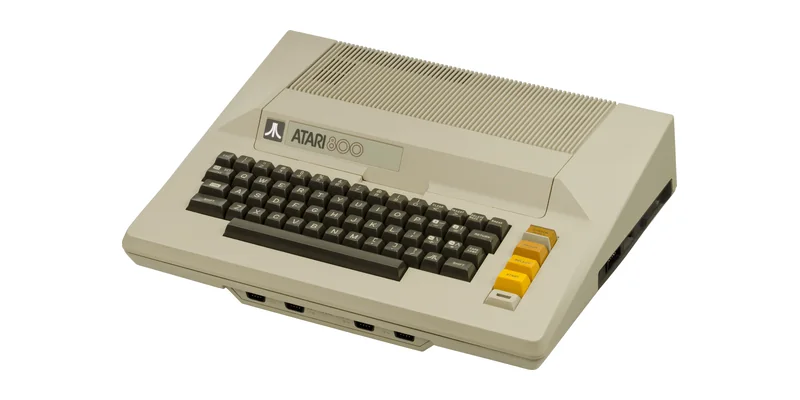
The people behind the computer
No single person designed the complete system. Architecture, logic design, chip layout, circuit boards, mechanical engineering, operating software, and manufacturing were separate kinds of work. These accounts provide particularly useful ways into that collaboration.
Steve Mayer: system conception
Mayer helped establish the system concepts from which Atari’s custom-chip machines grew. His Computer History Museum oral history describes the relationship between experimental hardware and the work of engineers who translated those ideas into integrated circuits. It is valuable context for understanding why a finished computer’s design cannot be reduced to a list of chip authors. [3]
Jay Miner: architecture and chip development
Miner was a central hardware architect and led the chip-development effort. Decuir’s interview identifies Miner and Mayer as close collaborators in creating the 400/800. Miner’s later association with the Amiga can overshadow his Atari work; the earlier project already demonstrates the importance of designing the processor, display hardware, and software model as a coordinated system. [1]
Read the extended Jay Miner profile below, from the Atari 2600 and 400/800 to the Amiga, with a guide to his surviving talks and interviews.
Joe Decuir: ANTIC and the system around it
Decuir helped design the architecture and ANTIC. His two engineering notebooks preserve the day-to-day setting of this work: testing, timing, meetings, storage questions, and revisions. His interview adds explanations of the intended home audience and the constraints on expansion. Read the notebooks alongside the later recollection: one records decisions as they developed, while the other explains their significance with hindsight. [1] Notebook guide.
Doug Neubauer: POKEY and Star Raiders
Neubauer designed POKEY’s logic and wrote Star Raiders. His own POKEY account describes how a chip responsible for keyboard and paddle input also became the sound and serial-I/O workhorse. This combination made POKEY much more than a music generator. His game then showed what the complete computer could do through a cockpit display, navigation, sound, and real-time action. [4] [5]
The wider engineering team
The physical implementation required specialist work beyond the best-known architects. Steve Stone’s interview covers POKEY and ANTIC layout and the tools used to turn logic into manufacturable silicon. It is an especially useful counterweight to accounts that treat an integrated circuit as the work of only its logic designer. [6]
George McLeod’s CTIA/GTIA work and François Michel’s ANTIC work belong in the wider attribution record, alongside circuit, packaging, and manufacturing contributors. The linked designer index provides a broader roster and separates these roles; it should be treated as a compiled credit list, not as a firsthand interview or an exhaustive organizational chart. [7]
A small team of processors inside one machine
| Component | Responsibility and consequence |
|---|---|
| 6502 CPU | Runs the operating system and application. It shares access to memory with display DMA, so graphics activity still affects available CPU time. |
| ANTIC | Reads a display list and screen data from memory. Different display modes can appear in one screen; scrolling and display-list interrupts give software further control. |
| CTIA / GTIA | Combines playfield and player/missile information into video, handles priorities and collision reporting, and supplies color control. GTIA is a later development, not a feature of every launch machine. |
| POKEY | Provides four audio channels, timers, keyboard scanning, paddle measurements, random-number facilities, and serial communication support. |
| PIA and SIO | The parallel interface supports control and joystick functions. The external Serial Input/Output bus connects intelligent peripherals through a shared protocol. |
Atari’s own Technical Reference Notes explain these interfaces; De Re Atari explains how programmers combine them. A display list is effectively a small screen-building program. It can describe text at the top, a graphics area in the middle, and a different display region below. Player/missile graphics provide separately positioned shapes that do not require rewriting the whole background whenever they move. Neither feature removes all work from the CPU, but both change what is practical on a home computer. [2] [8]
The 800’s internal boards provided a different kind of flexibility: memory could be added within the machine. External disks and printers generally used SIO rather than Apple II-style expansion cards. That choice helped create a consistent peripheral connection, while placing more responsibility in the peripherals themselves. The operating system’s device handlers made those connections usable by programs. [2]
Read Joe Decuir’s engineering notebooks
These are the two original PDFs preserved in this site’s history folder. Both identify Joe Decuir as author and the Internet Archive as digitizer. They are handwritten scans with no useful searchable text layer. The PDF page number includes covers and other front matter, so it differs from the handwritten engineering-sheet number.
- 1977 engineering notebook — PDF, 124 pages. Internet Archive record. This volume includes VCS work as well as the broader development setting. On PDF page 8, a Stella log discusses debugging, television audio, and a modification by Niles Strohl to a KIM development system. It demonstrates the practical testing work behind the later architecture.
- 1978 engineering notebook — PDF, 108 pages. Internet Archive record. On PDF page 8, engineering sheet 4, Decuir records a January 13 meeting on cassettes and disks, including alternatives for carrying digital data and audio. The notes connect the computer’s storage design with cost and signal-quality questions.
These examples are reading entry points, not a complete transcription. A proposal in a notebook is evidence that an option was considered; it does not by itself establish that the option appeared in production hardware.
Development chronology
- 1977: The VCS reaches the market while Atari engineers pursue a more capable generation of hardware. Decuir’s notebook preserves the overlap between these efforts.
- 1978: Work on the computer architecture, custom chips, storage, and system software converges. Atari brings in Shepardson Microsystems for BASIC and a disk file manager.
- January 1979: Atari demonstrates the 400/800 generation at Winter CES. Working software is essential to making the hardware meaningful to visitors.
- Later in 1979: The machines reach customers. Cartridge applications and games help establish the new platform.
- Early 1980s: GTIA-equipped machines and a growing software and peripheral ecosystem extend the original design. The XL and XE later preserve its central architecture.
For the late-1978 software deadline and CES preparation, see the developers’ account in the OS, DOS, and BASIC history. Announcing a product, demonstrating it, and delivering retail units are distinct milestones.
The hardware became a platform through software
The 800’s long life came from the interaction of its hardware with a consistent software environment. BASIC exposed graphics and sound commands to beginners. The operating system provided common input/output services. Games could use those services or work closer to the hardware when speed demanded it. Technical books helped a wider community learn the system’s less obvious capabilities.
That continuity explains how a machine designed in the 1970s could remain the foundation of the XL and XE families. It also explains why those later machines inherited compatibility constraints: software had learned not just the documented interface, but the behavior of particular ROMs and chips.
Jay Miner: from television games to personal computers
Jay Miner belongs near the center of the Atari 800 story. His contribution was the combination of integrated-circuit expertise, system architecture, and leadership of the engineers who made the machine practical. The Atari VCS, the 400/800, and the Amiga show three stages of that work: inexpensive programmable television games, a computer with a programmable display processor, and a more ambitious computer with several cooperating graphics and sound engines. The comparison below follows the hardware; the interviews explain the people and decisions behind it. [11] [12] [15]
Learning to design chips before Atari
Miner’s 1988 account traces his electronics background to Coast Guard radar and radio work, an engineering degree in 1958, and self-taught transistor and logic design. From 1964 he worked at General Micro Electronics in the emerging MOS field. Calculator, watch, and computer-chip projects gave him extensive experience before Atari. [9]
The Atari 2600: making the TIA possible
Al Alcorn’s Smithsonian oral history explains why Atari sought Miner out. Harold Lee, who had worked on Atari’s Pong chip, recommended him for the more demanding programmable system. Alcorn recalled arranging for Miner to work with Atari while employed by Synertek. The project needed expertise in dynamic logic, and Miner joined Joe Decuir and Larry Wagner in bringing the Grass Valley design into production. This was a specific engineering need: Atari had a promising architecture, but still had to make a reliable, manufacturable chip. [10]
Steve Mayer and Ron Milner had developed the original concept and prototype. Ron Milner and Jay Miner were different engineers. Decuir’s 2005 interview describes his own work developing the display engine and using games as hardware tests. Software and circuitry evolved together: adding a few gates could simplify a program, while a clever program could avoid more hardware. Miner’s chip work belonged within that exchange. [18]
The production Television Interface Adaptor, or TIA, gave the VCS its video and sound hardware. Without a framebuffer holding a complete image, cartridge software changed display registers in step with the television beam. Racing the beam describes this relationship between instruction timing and visible output. [11]
A revealing detail in IEEE Spectrum’s contemporary account is the use of compact polynomial counters for object positioning. These saved silicon compared with ordinary binary counters but complicated the programmer’s job. The production design by Decuir and Miner retained that tradeoff. Cost, chip area, and programming difficulty were connected decisions; the hardware’s apparent simplicity depended on considerable ingenuity on both sides of the cartridge connector. [11]
The 400/800: directing an entire architecture
Doug Neubauer’s recollection supplies a particularly clear description of Miner’s position: manager, creator, and system architect of the chip-design group. Neubauer identifies Steve Mayer as another originator, Joe Decuir with ANTIC and system design, François Michel with ANTIC logic, and George McLeod with CTIA/GTIA logic. Neubauer himself designed POKEY’s logic. Mark Shieu, Steve Stone, Steve Smith, and Delwin Pearson appear among the chip, layout, and technical contributors. [12]
Miner led the system’s development; other engineers implemented substantial parts. Neubauer’s admittedly incomplete roster makes that distinction explicit. [12]
The architectural advance over the VCS was fundamental. ANTIC could fetch instructions from a display list and retrieve the data needed to draw the screen. CTIA combined the playfield with player/missile graphics and handled the final display relationships. The CPU still shared memory time with video hardware, but no longer had to construct every ordinary scan line through a tightly timed program. The component table above explains how these jobs were divided. [2] [8]
There is also a substantial written engineering record bearing Miner’s name. US patent 4,296,476, Data processing system with programmable graphics generator, names Steven T. Mayer, Jay G. Miner, Douglas G. Neubauer, and Joseph C. Decuir as inventors. It was filed on January 8, 1979, and published on October 20, 1981. Its description explains a display generator executing instructions from memory and fetching graphics independently of the CPU’s instruction stream. [13]
For readers who want to go beyond recollections, its drawings are a useful companion to the notebooks: Figure 3 presents the system, Figures 4A and 4B the graphics generator, and Figure 7 the memory organization. This is a jointly credited technical document, not a personal memoir; the patent does not divide every circuit decision among its inventors. [13]
Leaving Atari and pursuing a 68000 computer
Miner connected his departure from Atari with a rejected 68000-computer proposal and compensation disagreements. This is his retrospective explanation of the dispute. [9]
His work outside home computing deserves attention too. A 1981 patent application, published as US 4,404,972 in 1983, names Pat L. Gordon, Richard V. Calfee, and Jay Miner for an implantable device with microprocessor control, assigned to Intermedics. It addresses a problem very different from television graphics: obtaining useful programmable behavior from a device with a severely limited battery supply. [14]
The proposed processor activates in response to selected events, performs the required routine, then deactivates internal logic until further work is necessary. Different counting rates reduce unnecessary switching. This gives readers a concrete example of Miner’s wider engineering work: deciding when hardware must operate, and when it can conserve energy, could matter as much as adding computational power. [14]
In the preserved 1990 interview, Miner described Larry Kaplan’s 1982 approach about a new games business. Miner connected Kaplan with Zymos president Bert Braddock and financing contacts; Dave Morse became president of the venture. After Kaplan left, Miner agreed to lead engineering on two conditions: use the 68000 and allow the product to become a computer. The surviving machine transcript is useful for locating this account, although names and wording should be checked against the recording. [25]
That compromise explains much about Amiga’s beginnings. Investors could pursue a games product, while Miner could develop hardware with broader uses. In the same interview he described wanting a machine capable of competing in business computing as well as entertainment. The later Amiga was shaped by that ambition and by arguments over what the company could afford. [25]
The Amiga: graphics, sound, and room to grow
Miner’s 1985 BYTE interview with hardware director Bill Kolb is particularly valuable because it dates from the first Amiga’s launch year. Miner explained that the project began with a much cheaper games-machine target and grew as the team added capabilities. Software developers pressed for hardware line drawing and area filling. Kolb described the three custom chips as a closely connected system divided into separate devices for practical implementation. [15]
| Chip | Work within the system |
|---|---|
| Agnus | Generates addresses and manages direct memory access for the cooperating hardware. |
| Denise | Handles the main video-output work. |
| Paula | Handles audio and important input/output functions. |
Programmers controlled these interdependent parts through a coordinated register interface. [15]
A team around the chips
Carl Sassenrath’s own team roster identifies Miner as hardware team leader and an Agnus contributor. It also credits Dave Needle with Agnus and system boards, David Dean with Denise, and Glenn Keller with Paula. Decuir independently records his early Amiga work on chipset architecture and Agnus. The overlap is another reason to describe contributions rather than assign exclusive ownership of a chip to one person. [17] [18]
The software side was equally substantial: Bob Pariseau led that team; Sassenrath developed the Exec kernel; RJ Mical developed Intuition; Dale Luck worked on graphics; and Sam Dicker worked on sound. The hardware needed software that could expose its capabilities to applications and users. Sassenrath’s roster names further device, graphics, printer, and input contributors and explicitly acknowledges people beyond engineering. [17]
How the ideas developed beyond ANTIC
The Amiga’s Copper is a useful comparison with ANTIC’s display list, although their instructions and jobs differ. A Copper program can wait for a screen position and then write hardware registers. Commodore’s manual gives examples of changing sprite colors between different parts of a display and resetting the pointers used to fetch image data. The programmer can schedule visual changes without making the CPU execute each register write at exactly the right instant. [24]
This is an architectural comparison, not a claim that the Amiga contains an ANTIC. The common idea is to give a display-related task its own small program and let specialized hardware carry it out. ANTIC’s display instructions organize Atari screen construction; the Copper schedules changes to Amiga hardware as the display progresses. Reading the two programming descriptions side by side makes the relationship clearer than simply calling the Amiga an improved Atari 800. [8] [24]
Miner wanted affordable home flight simulation after seeing professional simulators. He connected blitter hardware and independent sound channels with that ambition. [9]
Hold-and-Modify, or HAM, illustrates how a feature’s eventual use could surprise its designer. In 1992 Miner recalled nearly removing it after the video design changed, then retaining it when removal would have complicated the chip layout. He acknowledged that programmers made more of it than he had expected. This is his retrospective explanation of the decision, rather than a surviving design-change record. [16]
Working with Miner
Miner’s 1992 recollections describe a workplace that valued ability over conventional appearance or working habits. His dog Mitchy came to work; he connected that welcome with the team’s wider tolerance of eccentric people. He recalled arguments over inexpensive game hardware versus a more expandable computer, and software developers helping determine what went into the chips. His account presents leadership as recognizing talent and allowing it to influence the design. [16]
The personal association survives in a physical artifact. The Amiga 1000 case includes the designers’ signatures and Mitchy’s paw print. It commemorates a group of people whose work was inside the machine, alongside the dog who became part of their working environment. [26]
Commodore, later opinions, and his wider legacy
Amiga’s financial problems brought it into negotiations involving Atari and ultimately into Commodore. The recollections of Miner and Decuir emphasize different aspects of those dealings. They should not be compressed into a claim that Miner designed the Atari ST, or that the ST project began only after Atari failed to obtain Amiga’s chips. The separate ST history follows that team’s development. [18]
The Amiga’s public launch took place on July 23, 1985, at the Vivian Beaumont Theater in New York’s Lincoln Center. Andy Warhol’s onstage work with Debbie Harry’s image showed the machine as a creative tool as well as a computer. The Computer History Museum’s account is a useful chronology check: the republished 1988 Miner interview instead says 1984 and Rockefeller Centre. Here the event record takes precedence over that detail in the recollection. [19]
In the interview published in Dutch Amiga Magazine in early 1994, Miner gave a striking answer when asked what most distinguished the Amiga: its operating system. He singled out Sassenrath, while saying the custom hardware could have offered more. The best-known chip designer was willing to place software at the center of the machine’s value. [20]
He remained an active user, describing an accelerated A2000 running a bulletin board and an A4000/040. His criticism of Commodore focused on marketing, applications, and developer support, alongside the pace of technical development. He also discussed later work on implantable defibrillator electronics. These recollections give a fuller picture than the familiar title “father of the Amiga”: a designer who used the machines, admired other people’s work, and kept applying his skills outside personal computing. [20]
Miner died in 1994. Neubauer’s remembrance and Sassenrath’s team record preserve his colleagues’ regard for him. [12] [17]
Hear Jay Miner: talks and interviews
The recordings and printed interviews complement one another. For a first visit, start with the long AmiExpo talk, then read the BYTE interview for engineering detail. The following guide distinguishes public recordings, published transcripts, and material catalogued in a commercial preservation collection.
- The Amiga from the Beginning — AmiExpo East, March 18, 1990. Listen to the recording published by The Guru Meditation, approximately 68 minutes. The uploader, Amiga Bill, describes attending the event and rediscovering the recording kept by his family. The event description places it in Washington, DC, and lists the company’s beginnings, custom chips, Commodore, and the Boing Ball among its subjects. This is a listening entry point; the descriptions, rather than an independently checked transcript of the entire recording, establish this guide’s topic list. [21]
- Jay Miner Speech — catalogued as 1989. Cloanto’s Amiga Forever video catalogue lists a 49-minute speech, distinct from the 1990 AmiExpo recording. The catalogue describes its preservation sources and subtitles. The full collection is a commercial release; the catalogue also links to selected online videos. [22]
- Paris interview — February 9, 1990. Read Cloanto’s account of recording and restoring the interview. Recorded with developers in the hotel bar during the Amiga Developers Conference, it ranges beyond the company’s origins into computers and society. Cloanto explains that declining recorder batteries affected playback speed and that the audio required restoration. Its collection presents excerpts with a photograph and scrolling transcription. [23]
- The Amiga’s Custom Graphics Chips — BYTE, November 1985. Read the magazine scan, beginning at printed page 169. Philip Robinson interviews Miner and Bill Kolb. [15]
- Miner’s retrospective — Amiga User International, June 1988. Read the republished interview. An extensive account covering his earlier career and views about Amiga. The modern editor could not identify the original interviewer. [9]
- Pasadena interview — September 1992. Read the archived transcription. Particularly useful for working culture and design compromises. Check its imperfect transcription against the original before quoting it. [16]
- Amiga Magazine, issue 25 — January/February 1994. Read the English translation. Links to the Dutch text and issue archive accompany this translation. [20]
This profile is an editorial synthesis, not a transcript or a text written by Miner. Contemporary technical records establish hardware behavior; interviews preserve participants’ explanations and opinions. Dates attached to events, original publication, and modern republication are kept separate. The sources below also provide entry points for further reading without reproducing complete copyrighted interviews.
Interviews, articles, and original documents
- ANTIC Interview 44: Joe Decuir (May 17, 2015). Recorded designer interview about the 400/800’s goals and constraints.
- Atari 400/800 Technical Reference Notes — local PDF. Atari’s hardware and OS interface documentation; use it to check the implemented architecture.
- Computer History Museum: Oral History of Steven Mayer — PDF. Firsthand account of systems, research, and custom-chip development.
- Doug Neubauer: The POKEY Chip Story. The designer’s own account.
- Halcyon Days: Doug Neubauer interview. A game-design perspective on Star Raiders and Atari hardware.
- ANTIC Interview 228: Steve Stone. POKEY and ANTIC layout design and engineering tools.
- Atari 8-bit FAQ: designer credits. A secondary research index for the larger team, with roles distinguished by model.
- De Re Atari — local PDF. Atari’s technical explanations for programmers. Also see the local Star Raiders source listing.
- Jay Miner interview, Amiga User International, June 1988. Republished January 21, 2018. Firsthand retrospective; see the launch-date correction above.
- Smithsonian: Allan Alcorn oral history, March 16, 2018. PDF page 43 discusses recruiting Miner.
- IEEE Spectrum: Inventing the Atari 2600. Contemporary reporting with the engineers’ explanations of prototypes, production circuitry, and programming tradeoffs.
- Doug Neubauer: The Atari Years. Participant’s recollection.
- US 4,296,476: Data processing system with programmable graphics generator. Joint technical record with searchable text and downloadable drawings.
- US 4,404,972: Implantable device with microprocessor control. A written record of Miner’s work beyond home computers.
- BYTE, November 1985. Interview begins on printed page 169.
- Jay Miner interview, Pasadena, September 1992. Archived transcription.
- Carl Sassenrath: Dale Got Married — Amiga Design Team Photo 2007. Includes his extended engineering credit list.
- Scott Stilphen’s Joe Decuir interview, 2005. Firsthand recollections of Atari and Amiga; retrospective dates and business details require comparison with other records.
- Computer History Museum: Warhol & The Computer. Documents the 1985 launch and demonstration.
- Jay Miner, Amiga Magazine issue 25. English translation with links to Dutch sources.
- The Guru Meditation: Jay Miner at AmiExpo East 1990. See also Amiga Bill’s September 10, 2020 preservation account and the recording description and event date.
- Amiga Forever: video catalogue and preservation notes.
- Cloanto: Interview with Jay Miner, February 9, 1990. Recording provenance and restoration account.
- Commodore Amiga Hardware Reference Manual: Putting Together a Copper Instruction List. Publisher documentation preserved online.
- Jay Miner 1990 interview: machine transcript. A locating aid, not an authoritative edition; the page’s generated segment timings extend beyond its stated running time and should not be used as reliable timestamps.
- Computer History Museum: 1985 timeline. Amiga 1000 case signatures and Mitchy’s paw print.