The project began before the new Atari
Planning for the machine that became the ST started at Tramiel Technology in the spring of 1984, before Jack Tramiel acquired Atari’s consumer business. Jeffrey Daniels’ 1988 START article, Three Years with the ST, interviews the participants and describes a small group of former Commodore employees defining an affordable new computer. The Atari acquisition supplied the company, staff, facilities, and distribution identity within which that plan could become a product. [1]
The acquisition did not include the coin-operated arcade business, which continued separately. For engineers inside the consumer operation, the transition meant layoffs, moves, uncertain reporting relationships, and unfamiliar colleagues. Landon Dyer’s account begins with that experience rather than with a polished product announcement. He was retained after interviews with Leonard Tramiel and John Feagans and moved from game development into the new computer’s software effort. [2]
Those two perspectives belong together. Management had a computer strategy before many retained Atari employees knew its details. The fact that the plan predated the takeover does not mean that finished ST hardware was waiting inside the old Atari, or that the subsequent engineering was routine.
People who made the ST
Shiraz Shivji: engineering leadership
Shivji led the new hardware effort. In the START interview he describes the processor-selection discussions and the sprint from plans to custom chips, boards, monitors, and plastic enclosures. His account emphasizes how much had to happen in parallel. Even a working circuit would not have been a shippable consumer product without tooling, testing, reliable parts, and software. Read Shivji’s interview comments [1].
The extended Shiraz Shivji profile below follows his education, calculator and computer work at Commodore, decision to join Tramiel, and approach to leading the ST’s development.
Jack and Leonard Tramiel: product and software decisions
Jack Tramiel supplied the commercial direction and pressed the team to deliver a competitively priced computer. Leonard was closely involved in technical discussions and the operating-system choice. START records his explanation of choosing Digital Research and later taking the risk of GEMDOS rather than the more mature CP/M-68K. Dyer describes Leonard’s role from the software team’s side. [1] [3]
John Feagans: early strategy and staffing
Feagans participated in the early evaluation of Digital Research’s graphical software and in selecting retained Atari programmers. His START comments recall seeing the system when it was still called Crystal. Dyer’s account supplies a complementary view of Feagans’ interviews with staff after the takeover. [1] [2]
Landon Dyer, Mike Schmal, and the systems programmers
Dyer worked on BIOS and operating-system bring-up. His two accounts describe the workstations, prototype failures, boot-ROM loader, and memory squeeze. START identifies Mike Schmal as one of the architects of the ST system software and records his explanation of GEMDOS’s familiar programming model. These are useful accounts of the people who made the hardware into a usable computer. [3] [1]
Dave Staugas and the graphics programmers
Staugas ported text-blitting code and later wrote NEOchrome. His START recollection of repeatedly changing source material is a vivid example of the difficulty of porting an interface that was still being developed. Dyer also names Jim Eisenstein among the graphics people and describes the graphics team’s game-programming background. Their work mattered both to performance and to the machine’s first public impression. [1] [2]
The TOS history continues with Digital Research’s contributions. The named people here are documented participants, not an exhaustive hardware or software credit roll.
Why the Motorola 68000?
The ST name refers to “sixteen/thirty-two”: the 68000 combines a 16-bit external data bus with a programming model featuring 32-bit registers. National Semiconductor processors were also considered. Shivji emphasizes availability, price, and disappointing prototype performance in explaining the eventual decision; Dyer remembers the 32000 family as an early contender. The selection was therefore a product decision involving tools and supply as well as an instruction-set preference. [1] [2]
The original ST architecture combined the 68000 with custom support chips and familiar peripheral devices. The MMU coordinated DRAM access; GLUE handled system control and timing; the Shifter produced the video stream; DMA hardware supported disk transfers. The Yamaha sound chip and separate keyboard controller supplied other functions. The machine was not an enlarged Atari 800: its display organization, CPU, ports, and software interfaces required a new generation of applications. [4]
| Feature | Why it mattered |
|---|---|
| 8 MHz 68000 | A larger address space and more capable programming model than the 8-bit family. |
| Color display modes | 320 × 200 with 16 colors, or 640 × 200 with four, selected from a 512-color palette. |
| Monochrome display | 640 × 400 with a compatible high-resolution monitor; especially useful for text, programming, and detailed applications. |
| Mouse and GEM | A graphical desktop and common interface conventions for applications. |
| MIDI In and Out | A direct connection to compatible musical instruments, making music software practical without an extra interface purchase. |
| Disk and peripheral interfaces | Floppy, hard-disk/DMA, printer, and serial connectivity for a more general-purpose desktop system. |
The specifications above describe the classic ST; later STE, TT, and Falcon capabilities should not be projected backward onto the launch machine. Consult the local Atari ST Internals and First Atari ST Book for the hardware and programming environment. [4] [5]
Five machines and a demonstration deadline
The January 1985 Consumer Electronics Show was a hard target. Dyer remembers unreliable wire-wrapped prototypes and the difficulty of distinguishing a software failure from a bad physical connection. The software team used other 68000 systems because dependable ST hardware was not available early enough. This made the final assembly of hardware and software a substantial risk.
Both Dyer and START describe only a handful of working machines at the show. Dyer recalls repairs behind the scenes as systems failed on the floor. The public saw a graphical computer; the engineers were also demonstrating that enough of a still-changing design could survive a trade show. The CES software used CP/M-68K beneath GEM. The adoption of GEMDOS came afterward. [2] [3]
From the 520ST to the 1040ST
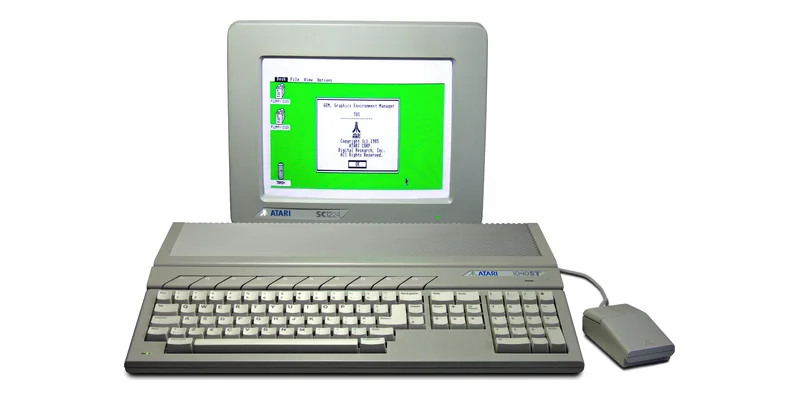

The 520ST reached customers in 1985 with 512K RAM. Early systems loaded TOS from disk, consuming part of that RAM; later ROM-based TOS changed the startup experience. The original physical arrangement used external components, including the disk drive and power supply. The 1040STF, introduced in 1986, provided one megabyte of RAM and integrated the floppy drive and power supply into a larger keyboard unit. [5] [1]
The F suffix identifies an integrated floppy drive; M identifies an RF modulator on models equipped for television output. Model suffixes matter when comparing photographs, ports, and startup arrangements.
The 1040 was an evolution of the ST platform, not a separate operating-system project. More RAM made larger applications and documents practical, while integration reduced the number of separate boxes on a desk. START recalls the contemporary attention to the machine’s price per kilobyte. The commercial success of that packaging should be considered alongside the earlier engineering effort that made a common software platform possible.
Development and model chronology
- Spring 1984: Tramiel Technology begins defining a new affordable computer.
- July 1984: Acquisition of Atari’s consumer business joins the plan to retained staff and facilities.
- September 1984: Atari programmers begin the intensive Digital Research collaboration in Monterey.
- January 1985: Working STs appear at CES, with GEM over CP/M-68K.
- Early 1985: The team changes to GEMDOS, completes software, and supplies developer systems.
- Mid-1985: The 520ST reaches the market; ROM availability and installation evolve after the first disk-based systems.
- 1986: The 1040STF combines a megabyte of RAM with an integrated drive and power supply.
- 1987: The Mega ST brings a separate keyboard, battery-backed clock, and Blitter graphics acceleration. [11]
- 1989–1990: The STacy makes the original ST portable; the STE adds enhanced graphics and sampled stereo sound. Both appear in 1989, with US sales following in 1990. [13] [14] [15] [12]
- 1990–1991: The TT030 takes the range into 68030 workstation territory. The Mega STE follows with a faster 68000 and STE features in a desktop case. [16] [17]
- 1991–1992: The ST Book is demonstrated, then reaches a small European market as a lightweight notebook. [20] [21] [19]
- 1992–1993: The Falcon030 introduces a DSP, richer graphics, and 16-bit audio. Its 1992 introduction precedes general retail availability in 1993, including the US. [25] [26]
The models: hardware, TOS, and US availability
The ST family branched into home computers, desktop publishing systems, portables, and workstations. A later release did not necessarily include every feature of an earlier one. This comparison includes the TT and Falcon as successors to the original ST platform.
Dates distinguish introductions from later sales where that matters. TOS entries describe factory versions across production runs, followed by relevant upgrade notes. A surviving computer may have replacement ROMs, memory, or disk drives. “US” means an official market release, rather than an imported example or a machine shown at an American trade show.
| Model and introduction | What changed | TOS supplied | US availability |
|---|---|---|---|
| 520ST / 520STM 1985–1986 |
8 MHz 68000, 512 KB RAM, external floppy and power supply. The M version adds a TV modulator. Original ST graphics, Yamaha sound, and MIDI; no standard Blitter. | Disk-loaded TOS initially, then ROM TOS 1.00. Later machines/replacement ROMs may have 1.02 or 1.04. [1] [22] | Yes. The 520ST reached US customers in 1985; the STM followed. [28] |
| 520STF / STFM and 1040STF / STFM From 1986 |
Integrated floppy and power supply; 512 KB in the 520, 1 MB in the 1040. FM adds TV output. The CPU, normal display modes, and sound remain classic ST. Drive mechanisms and motherboard revisions vary. | 1.00, then 1.02 and later 1.04 across the family. F or FM does not identify the TOS revision. [5] [22] | Yes, the integrated-drive ST family was sold in the US; suffixes and packages varied by market. [1] |
| Mega ST 2 / 4; later Mega 1 1987 onward |
Still an 8 MHz 68000 and classic ST video/sound. Separate keyboard, internal expansion connector, battery-backed clock, and Blitter. Initially 2 or 4 MB; a cheaper 1 MB model followed. [11] [19] | 1.02 initially; 1.04 on later units. A modern 2.06-equipped Mega ST has been upgraded. [22] [23] | Yes: Mega 2 and Mega 4 were US products. Do not confuse them with the later Mega STE. [11] |
| STacy 1989; US sales in 1990 |
Portable 8 MHz ST with a backlit 640 × 400 monochrome LCD, trackball, and internal floppy; hard-disk configurations also offered. Heavy transportable design, without a Blitter. [14] | 1.04, “Rainbow TOS.” [22] | Yes, but with a significant qualification: the STacy 2 and 4 initially reached professional buyers through music stores, rather than a normal home-computer launch. [15] |
| 520STE / 1040STE 1989; US 1040STE in 1990 |
8 MHz 68000; 512 KB or 1 MB, with plug-in memory expansion to 4 MB. Blitter, 4,096-color palette, fine hardware scrolling, 8-bit stereo DMA sound, and enhanced controller ports. [12] | 1.06, then corrected 1.62. The period name “TOS 1.6” usually means 1.06. TOS 2.06 is a later upgrade option. [22] [23] | US release is documented for the 1040STE. The sources here do not establish a separate US 520STE launch. [12] |
| TT030 1989 preview; production 1990 |
Production CPU: 32 MHz 68030, with 68882 floating-point coprocessor. Expandable ST-RAM and faster TT-RAM, SCSI, VME expansion, additional video modes, and DMA stereo sound. No Blitter. [16] | 3.01, then 3.05 and 3.06. TOS 3 supports TT hardware; it is not an ST ROM upgrade. [19] | Yes. Initial US dealer shipments were reported in December 1990 for commercial use, with distribution restricted to qualified dealers and value-added resellers. [32] |
| Mega STE Late-1990 announcement; 1991 sales |
STE graphics, Blitter, and DMA sound in a separate-keyboard desktop. Switchable 8/16 MHz 68000 with 16 KB cache, VME expansion, extra serial/LAN connections, and internal hard-disk options. [17] [16] | 2.05, later 2.06, with the expanded desktop. RAM/hard-disk packages varied; neither the case nor TOS alone guarantees a high-density floppy drive. [19] [23] | Yes. US and Canadian shipments were reported by June 1991. [18] |
| ST Book 1991 demonstrations; limited 1992 sales |
Low-power 8 MHz notebook with 640 × 400 monochrome screen, no backlight, no internal floppy, internal IDE hard disk, and a pointing pad. Includes Blitter functionality. The documented retail example has 1 MB RAM and a 40 MB disk. [20] [21] | Special ST Book version of 2.06, often catalogued as 2.08; see the naming note below. [19] [27] | No official US release. The period Atari Compendium records a small Europe-only release, despite earlier US demonstrations and plans. [19] |
| Falcon030 1992 introduction; 1993 retail rollout |
16 MHz 68030 plus 32 MHz Motorola 56001 DSP; Blitter, new VIDEL graphics, 16-bit stereo recording/playback, IDE and SCSI, and standard 1.44 MB floppy. RAM options: 1, 4, or 14 MB. [24] | 4.0x, with 4.04 the mature production version. Earlier revisions include 4.00/4.01/4.02. These are Falcon-specific ROMs. MultiTOS is a separate disk-loaded multitasking environment. [29] [30] | Yes. Introduced in the US in September 1992; Atari reported its US dealer network and Falcon distribution in June 1993. [25] [26] |
Regional names and unreleased machines
The 260ST and 520ST+ are early European variants, especially associated with West Germany, rather than regular US retail models. The shipped 260ST had 512 KB despite its name; the 520ST+ had 1 MB in the original external-drive form. They belong to the original ST generation, not the later STE enhancement. The regional model record is useful here because American announcements did not always become American products. [28]
The table covers released production families. Prototypes such as the ST Pad/STylus should not be counted as US releases simply because they appeared at trade shows. Likewise, an American owner or an English-language ROM does not by itself establish official US distribution.
When the important capabilities appeared
| Capability | Introduction and later differences |
|---|---|
| MIDI | Built into the original 520ST in 1985. Music connectivity was present years before the STE’s sampled audio or the Falcon’s DSP. [1] |
| Integrated floppy and power supply | The STF generation, beginning in 1986. This changed desk space and cabling, without changing the CPU or adding STE graphics. F means floppy; M means TV modulator. [5] |
| Blitter | The Mega ST introduced it in the 1987 production range, with TOS 1.02 support. It accelerates block copying and raster operations; it does not add colors or resolution. STE, Mega STE, ST Book, and Falcon also have it. STacy and TT do not. [11] [14] [16] [20] [24] |
| Enhanced palette and scrolling | The STE, unveiled in 1989, expands the palette from 512 to 4,096 colors and adds fine hardware scrolling. Normal low resolution remains 320 × 200 with 16 simultaneous colors; “4,096 colors” describes the palette. Mega STE retains these capabilities. [13] [12] |
| Sampled stereo audio | The STE adds 8-bit DMA playback alongside the original Yamaha sound generator. Mega STE and TT also provide DMA audio. The Falcon advances to 16-bit stereo input and output and adds the programmable DSP. MIDI and sampled audio are separate capabilities. [12] [17] [16] [24] |
| Faster processors and expansion | The TT’s 32 MHz 68030 and fast RAM target workstation work. Mega STE keeps the 68000 but offers 16 MHz and cache, plus an 8 MHz compatibility setting. Both offer VME expansion; the original Mega ST’s internal connector is different. [16] [17] [11] |
| New screen modes | TT modes include 320 × 480 in 256 colors, 640 × 480 in 16 colors, and 1280 × 960 monochrome with the appropriate display. Falcon adds flexible video modes including 640 × 480 in 256 colors and 16-bit true color; available combinations depend on the monitor and timing. [19] [24] |
| High-density floppy disks | A 1.44 MB drive is standard on Falcon. Earlier model names and ROM upgrades are not enough to identify drive capacity: early TT/Mega STE configurations and later hardware upgrades differ. Check the drive and controller as well as TOS. [24] [18] |
A Blitter needs both hardware and software support. TOS 1.02’s “Blitter TOS” nickname does not mean that every ST containing those ROMs has the chip. Some older machines were upgraded; board revisions and chip population differ. Applications must use the supported graphics routines or explicitly use the chip to benefit. Installing newer TOS alone cannot turn an STF into an STE. [22] [31]
How to read the TOS version numbers
1.00 → 1.02 → 1.04 is the principal classic-ST sequence. Version 1.02 adds Blitter and hardware-clock support; 1.04 improves disk operations and the desktop. 1.06 → 1.62 is the original STE branch. Period writing often shortens 1.02 to “1.2,” 1.04 to “1.4,” and 1.06 to “1.6.” These names should not be mistaken for additional releases. [22]
2.05/2.06 belongs to the Mega STE era. TOS 2.06 also became an upgrade for earlier STs and STEs; classic STs normally require an adapter or other hardware changes for the larger ROMs. It adds features such as desktop file icons, keyboard shortcuts, and drag-and-drop launching. 3.01/3.05/3.06 serves the TT, while 4.0x serves the Falcon. These are hardware branches, not a ladder of interchangeable upgrades. [23] [19]
The ST Book naming exception: the period documentation calls its operating system TOS 2.06. ROM catalogues often call the specialized Book version 2.08; the file-identification rules explicitly recognize a Book ROM whose header still reports 2.06. Both labels occur, so the machine-specific version matters more than the shortened name. [20] [27]
MultiTOS is separate from the ROM version. Atari’s installation guide describes loading the multitasking environment from disk. A Falcon’s TOS 4.04 ROM is therefore not, by itself, evidence that MultiTOS is running. The TOS history explains the underlying operating-system components. [30]
Shiraz Shivji: the experience behind the ST
Shivji brought experience in calculators, home computers, and engineering management to Atari. The accounts below trace that experience and the working relationships behind the ST project. [7] [8]
From Tanzania to Southampton and Stanford
Shivji told Damien McFerran that his electronics interest began in childhood in Tanzania. After a first-class honours degree at Southampton, he pursued doctoral studies at Stanford. He earned a master’s and passed the qualifying examination, but left the PhD unfinished because money ran short. Silicon Valley work gave him hardware and software experience. [6]
A 1986 Happy Computer interview places his early Commodore work in the company’s calculator business. Shivji remembered that close exposure to small processors as formative: it taught him to look for capabilities that could be extracted from a modest amount of electronics. [9]
Commodore: calculators, the VIC-20, and engineering leadership
Michael Tomczyk’s 1984 book The Home Computer Wars identifies Shivji as a senior Commodore engineer. He had worked there during the calculator years, briefly left, and returned to help lead systems engineering after Chuck Peddle’s departure. [7]
Making the VIC-20 ready to sell
Tomczyk gives a particularly concrete example of Shivji’s contribution: Shivji and Fujiyama in Santa Clara performed most of the VIC-20’s FCC work. The computer’s radio-frequency emissions and certification were real obstacles to getting it into the American market. This puts Shivji directly in the work of turning a functioning design into a product that could be sold. [7]
Choosing an engineer for the TED project
Bil Herd’s firsthand recollection supplies another view of Shivji at Commodore. During Herd’s second week, Shivji, his boss and the head of engineering, brought him into his office. Shivji showed him a Sinclair Spectrum as the competing machine and put him in charge of a new computer using Commodore’s TED chip. [8]
Herd also recalls an earlier encounter about chip yield, when he had been unexpectedly called upon to represent engineering. His story shows Shivji identifying someone who could solve a practical problem and then giving that person substantial responsibility. It offers a useful example of his work as an engineering leader: judging people, establishing the competitive problem, and assigning the development work. [8]
Understanding his Commodore credit
Period profiles sometimes introduce Shivji as the creator of both the Commodore 64 and Atari ST. That shorthand leaves the division of work unexplained. The accounts above establish more specific responsibilities: systems engineering, production-related work, and leadership of other engineers. They support giving him substantial credit while remembering that a computer’s chips, board, firmware, and manufacturing preparation involve multiple contributors. The same distinction matters when describing his achievement at Atari. [9] [7] [8]
How he came to lead the Atari ST project
Shivji recalled being shocked by Jack Tramiel’s January 1984 departure from Commodore. He discussed joining Tramiel in another computer venture, with other experienced executives also interested. Their existing working relationship thus brought Shivji into the venture before the Atari acquisition. [6]
The START interviews date the early computer planning to late April or early May 1984. Shivji described a fairly clear product concept: a machine with a more capable processor, a graphical interface, good display facilities, sound, and MIDI. What existed at this stage was a direction and developing architecture. Detailed implementation still lay ahead. Acquiring Atari in July provided an organization in which the group could carry it out. [1]
Shivji recalled bringing four trusted hardware engineers from Commodore to work with retained Atari staff, and paying team travel expenses on his own credit cards during the transition. [6]
This helps explain why the move could lead so quickly to an ambitious project. Shivji brought working relationships as well as technical knowledge. Dyer’s account shows the other side of the merger: Atari programmers being interviewed, reassigned, and drawn into the new machine’s development. The resulting team combined people who knew one another from Commodore with programmers who knew Atari’s existing development environment. [2] [6]
His approach: make the whole computer work economically
In the 1986 Happy Computer interview, Shivji explained that he valued how much a system could accomplish with few components. Combining the functions of two chips in one was an achievement, but integrating that chip into a reliable system demanded a broader understanding. A small change could affect the entire machine. He encouraged aspiring engineers to study processors closely and build real circuits, where problems emerge that a schematic alone does not reveal. [9]
The processor decision illustrates that outlook. Shivji’s START account describes consideration of National Semiconductor parts before the team settled on Motorola’s 68000. Performance, availability in quantity, and price had to work together. A promising processor on paper was of limited use if the team could not obtain the parts needed for a consumer product. [1]
His responsibility also extended to coordinating the parts of development that could not wait for one another to finish. Custom chips, circuit boards, displays, and molded enclosures all had to progress toward the January 1985 CES demonstration. START records his pride in the roughly five-month hardware effort, while the software accounts show the continuing work needed to make those machines reliable and usable. The deadline was met through overlapping efforts across the team. [1] [3]
A glimpse inside his Atari laboratory
Happy Computer’s 1986 visit to Atari gives a picture of Shivji after the first ST launch. His small office contained a table covered with schematics and a terminal connected to a VAX used for development. He showed the visitor ongoing graphics work and introduced chip specialist “Duck” Renn, whom the article credits with GLUE and the Shifter. When questions turned to BASIC, Shivji brought in Leonard Tramiel. [10]
The reporter also describes an informal workplace where people used first names and worked without ties. Alongside new capabilities, the laboratory was pursuing lower component counts and cheaper packaging. These observations show the continuing combination of technical development, specialist responsibility, and attention to cost. The article’s prototypes and predictions should be read as a snapshot of work in progress, rather than a list of products that all reached shops. [10]
Read the accounts together
START’s article was written in 1988 and draws on several participants. Dyer wrote in 2008 and explicitly warns that his memory is selective. They agree on the broad sequence but do not supply an identical month-by-month software timeline. The new Part 1 and Part 2 pages preserve Dyer’s text so readers can make their own comparisons.
The START article also discusses products expected in 1988. Those passages document expectations at the time; they are not proof that every promised product subsequently shipped. Its relevance here is strongest in the interviews about the ST’s origins, engineering, software decisions, and early market experience.
Articles, firsthand accounts, and PDFs
- Jeffrey Daniels: “Three Years with the ST”, START, volume 3, number 1, Summer 1988. Interviews with Shivji, Leonard Tramiel, Feagans, Staugas, Schmal, and others. Original locally saved HTML is also preserved.
- Landon Dyer: The Atari ST, Part 1 (March 12, 2008). Full local reading edition with attribution and context.
- Landon Dyer: The Atari ST, Part 2 (April 9, 2008). Software organization, development tools, and ROM work.
- Atari ST Internals — local PDF. Technical reference for the hardware and operating-system interfaces; not a memoir of the design team.
- The First Atari ST Book — local PDF. Period introduction to the machine and its software environment.
- Damien McFerran: “Atari ST”, Retro Gamer feature reprinted in Videogames Hardware Handbook, volume 1, second revised edition (2016), pages 126–129. Retrospective interview hosted on Scribd.
- Michael S. Tomczyk: The Home Computer Wars (1984), PDF reading copy. A participant’s account of Commodore. This PDF uses different pagination from the printed book.
- Bil Herd: “30 Years Later TED Finds His Voice: A Commodore Story Part I”, Hackaday, September 2, 2014. Firsthand recollection of receiving the TED assignment from Shivji.
- “Achieving So Much with So Little” — full English translation, Happy Computer, September 1986. Contemporary Shivji interview on his background and engineering principles. Also read the German original, “Mit so wenig so viel erreichen”.
- “Inside the Atari Lab” — full English translation with photographs, Happy Computer, September 1986, by “hb.” A reporter’s visit to Shivji’s laboratory. Also read the German original, “Computer-Schmiede »Atari-Lab«”.
- Jon A. Bell and Patrick Bass: “The Mega 4”, START, Winter 1987. Hands-on review and teardown.
- David Plotkin: “E Is for Enhanced”, START, December 1990. US 1040STE review.
- Andrew Reese: “The Future of Atari Computing”, START, December 1989. Reports the Düsseldorf STE and TT unveiling; prototype TT specifications differ from production.
- Atari Explorer: STacy preview, September/October 1989, PDF. Describes the portable’s hardware and absence of a Blitter.
- Jim Pierson-Perry: “Winter NAMM Show Report”, START, May 1990. Documents professional US STacy sales through music stores.
- Dave Small: “TTerrific!”, START, February/March 1991. TT review and Mega STE sidebar.
- Atari Explorer, March/April 1991, PDF. Mega STE coverage, including a hands-on review beginning on page 24.
- STix, June 1991. Period reports on Mega STE availability, certification, and planned high-density floppy upgrades.
- Scott Sanders: The Atari Compendium, chapter 1, pages 1.3–1.6. Hardware and TOS overview; explicitly identifies the ST Book’s Europe-only release.
- Mark Jansen: “Writing the ST Book,” interview with Atari engineer Tracy Hall, Atari Explorer, January 1992; reprinted in Z*Net, February 14, 1992.
- Paul Dion: “The ST Book 1/40 — In Use”, ST NEWS, volume 8, issue 2, 1993. Firsthand account of a retail purchase in late 1992.
- John Townsend, Atari Corporation: TOS version guide, AtariUser, June 1991, PDF.
- Z*Net, February 21, 1992: TOS 2.06 and the TOS Extension Card. Includes CodeHead’s upgrade announcement and desktop feature list.
- Atari Falcon030 Owner’s Manual, introduction and appendix D. Manufacturer’s hardware specifications.
- News, July–September 1992. Includes firsthand reporting from Atari’s September 1992 Boston-area Falcon introduction.
- Atari Explorer Online, June 26, 1993. Atari representatives discuss US Falcon dealers and distribution.
- Atari ROM identification rules, reproduced in magic-db. Identifies the ST Book “2.08” ROM by date despite its 2.06 version header.
- Atarimuseum: 520ST, 260ST, 520ST+, and 520STM. Collection documentation and regional introduction record; German.
- splitrom: ROM layouts and version identification. Documents Falcon ROM revisions and dates.
- Atari: MultiTOS Installation Guide, document 500067, revision A, PDF.
- Doug Wheeler and David Small: “The Quest for Speed”, START, December 1989. Includes discussion of Blitter upgrades for older STs.
- John Nagy: “1990: The Year of Atari in Review”, ST Journal/Z*Net, reprinted in ACE. The December entry documents initial commercial US TT shipments.