Why redesign a successful architecture?
The original 800 was designed with substantial shielding, internal plug-in boards, and a relatively large enclosure. By the early 1980s Atari needed to keep its software and peripheral investment useful while building a less expensive, more integrated computer. That problem was not solved simply by changing the case: RAM, board layout, power, connector placement, firmware, and expansion all had to be reconsidered.
The XL retained the essential 6502/ANTIC/GTIA/POKEY programming model. The redesign’s historical importance lies in making that architecture into a new family of products rather than inventing an unrelated machine. Atari’s XL OS addendum records the software consequences of this continuity and change. [1]
The 1200XL: a new direction, with compromises
Announced in December 1982 and sold in 1983, the 1200XL introduced a low-profile enclosure, 64K RAM, a new keyboard with HELP and function keys, built-in diagnostics, and revised ROM software. Tom Halfhill’s contemporary report captures Atari’s initial positioning of it as an improved high-end computer. It also illustrates why launch coverage must be separated from later experience: optimistic compatibility claims were made before the full range of older software had been tested by owners. [2]
The 1200XL used a BASIC cartridge. It did not have the built-in BASIC later associated with the 600XL and 800XL. It also had two joystick ports rather than the original computers’ four, and it lacked the exposed Parallel Bus Interface of the later 600XL/800XL. These distinctions matter when discussing “the XL series” as if all models were identical. [1]
Its revised OS provided facilities such as an international character set and self-test, but changed internal addresses and behavior on which some existing programs depended. A documented interface is a promise that can survive a new ROM; an address inside a private routine is not. The compatibility problem arose partly because software developers had learned to depend on both. The translator approach loaded an older environment for programs that needed it, trading some of the benefits of the new OS for compatibility. [1]
Designers, engineers, and firsthand accounts
Regan Cheng and the XL appearance
The 1200XL’s physical design set the visual direction for the family. Industrial designer Tom Palecki recalls arriving just as Cheng finished the 1200 enclosure and designing peripherals to match it. Palecki identifies his own work on the 1050 disk drive and Touch Tablet and describes the progression from sketches through tooling drawings. That account makes clear that industrial design involved coordinating production details, not merely drawing an attractive concept. [3]
Surviving concept sketches donated by Cheng show alternatives explored along the way. They are valuable original design artifacts, but an attractive drawing is not proof that a particular configuration was manufactured. [4]
Gregg Squires and the New York engineering group
Squires managed XL-series development from Atari’s New York operation. His ANTIC interview is accompanied by a 45-page January 1983 600XL product-status handout. The combination is unusually useful: a manager’s later recollection can be compared with the costs, dates, and unresolved issues recorded during development. [5]
Jerry Jessop: prototypes and production
Jessop’s account links manufacturing experience with engineering. He describes assembling original 800s and bringing up an early 800XL prototype, and discusses his preference for concentrating effort on fewer models. His memories help explain why a cheaper computer was also a question of product strategy: two nearly similar models could divide engineering effort without offering customers a compelling distinction. [6]
The broader credit record
The compiled designer index identifies Ajay Chopra, David Owen Sovey, and Larry Plummer in the 1200XL specification and engineering work; for the 600XL/800XL it names Squires, Bob Card, Steven Ray, Joel Moskowitz, Philippe des Rioux, and Glenn Boles, with Chopra associated with the Parallel Bus Interface specification. These are role-specific credits from a secondary index. They should not be read as a claim that each person has left a published interview, nor as a complete list of everyone who contributed. [7]
The 600XL and 800XL
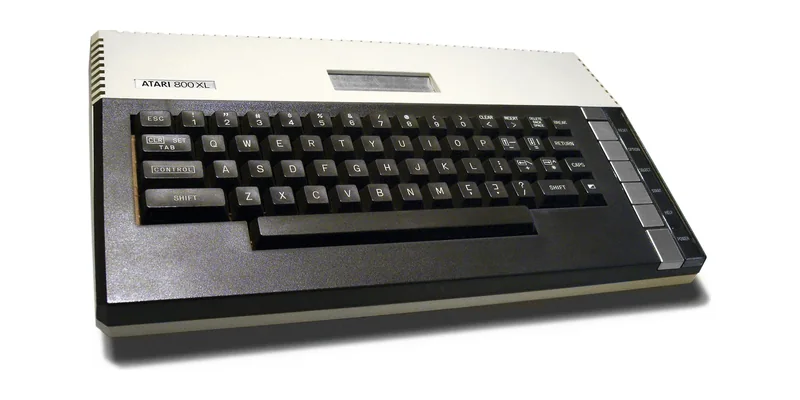
The next machines were a more direct attempt to offer the established Atari capabilities at lower cost. The 600XL supplied 16K RAM; the 800XL supplied 64K. Both included BASIC in ROM and an expansion connection through the Parallel Bus Interface. Their smaller footprints and common programming environment made them recognizable descendants of the original computers while addressing the practical limitations of the 1200XL product plan. [1]
The PBI gave expansion hardware access closer to the computer’s internal bus. It complemented SIO rather than replacing it, so owners could continue using serial peripherals. Atari’s OS support for parallel devices was therefore part of the product design, not an unrelated firmware feature. Expansion hardware could advertise handlers and services that the operating system would discover and use.
Memory also deserves a careful explanation. A 6502 has a 64K address space, but a 64K RAM computer must still map ROM and I/O into that space. XL control registers allow RAM and ROM visibility to change. “64K installed” is consequently not the same as “64K free for a BASIC program.” The OS, display memory, language workspace, and loaded disk software all affect what remains available. [1]
The software transition
Built-in BASIC simplified startup: with no overriding cartridge or disk configuration, the computer could enter the interpreter without a separate BASIC cartridge. The OPTION key became part of the boot procedure for users who wanted BASIC disabled. Programs and boot disks could require that extra memory, and instructions to hold OPTION became familiar to XL and XE owners.
Revisions of BASIC and the OS did not move in perfect lockstep. A report that software works on “an 800XL” is not always enough to identify the exact ROM combination being tested. The 8-bit software history explains the separate lineage of BASIC, the ROM OS, and Atari DOS. Reading these as distinct components avoids attributing a BASIC defect to the entire operating system.
Plans that did not become the standard machines
The XL design period produced more proposals than retail products. Cheng’s concept archive preserves modular and expansion-oriented ideas; Squires’ product-status material shows that decisions were still being refined even as the family took shape. These records should be read as branches of development, not as a simple sequence in which every prototype was released.
The 1400XL, 1450XLD, and 1090 expansion system are important adjacent projects, but the everyday platform inherited by most users was the 600XL/800XL combination. Their presence in development documents does not establish broad retail availability. The subsequent XE story begins with the existing XL architecture and further integration, during another major change in Atari’s ownership.
Chronology
- 1981–1982: Atari explores a successor to the original enclosure and board arrangement; surviving concepts show several directions.
- December 1982: The 1200XL is announced.
- January 1983: A detailed 600XL product-status document already records another part of the developing family.
- 1983: The 1200XL reaches users; the 600XL and 800XL follow as the principal compact XL models.
- 1984: Engineering continues on cost reduction and integration as Atari’s consumer business changes ownership.
- 1985: The XE generation carries the platform forward.
Interviews, design records, and PDFs
- Atari XL Addendum: Operating System Manual — local PDF. Primary documentation for memory control, OS changes, and the revised software interface.
- Tom R. Halfhill: “Atari’s New Top-Line Home Computer”, COMPUTE!, March 1983. Contemporary announcement coverage.
- Tom Palecki interview. Firsthand industrial-design account, including Cheng, the 1050, and the tooling process.
- Regan Cheng’s 1200/A300 concept drawings. Original sketches preserved by the Atari History Museum; the accompanying curatorial narrative is separate from the drawings.
- ANTIC Interview 383: Gregg Squires (published May 21, 2020; recorded February 13, 2019). The episode links the January 1983 600XL product-status handout.
- ANTIC Interview 30: Jerry Jessop and interview transcript. Manufacturing and prototype experience; consult the recording when precise wording matters.
- Atari 8-bit FAQ: designer credits. Secondary index of people and roles across the XL models.