About this translation
Original publication: Happy Computer, September 1986, in the “Computer & Ausbildung” (“Computers & Education”) section. The supplied text does not name an author.
German title: “Mit so wenig so viel erreichen” (Shiratz Shivji). Read the German original at the Computer Magazine Archive →
This full English translation was prepared for this site from the German text supplied by Bruce. It retains the article’s period language, opinions, and historical claims. Paragraph breaks have been added for readability, and obvious spelling and line-break artifacts have been normalized. The introduction and related-reading links are editorial additions.
This is a translation of a contemporary profile, not a revised historical account. For discussion of Shivji’s education and the division of engineering credit, see the Shiraz Shivji profile in Creating the Atari ST. The original photograph appears below with its caption translated into English.
Achieving So Much with So Little
Computers & Education
His very first creation became the most successful computer of all time, and his second has been the talk of the industry for a year: Shiraz Shivji, developer of the Commodore 64 and Atari ST, shares the experience behind his success.
Its sales figures broke every previous record: more than two million C64s have been sold worldwide. And with the ST series, Atari tore down the price barrier to the 16-bit market for home-computer enthusiasts everywhere. The ST series set new standards for value for money in computers, striking fear into many competitors. What do the two have to do with each other? A great deal! Both computers were developed by the same man.
Shiraz Shivji is the intellectual father of both the C64 and the Atari ST! With his intelligence, ingenuity, and commitment, he made computer history. Who is this man whose computers are giving fresh impetus to an entire generation, quietly changing the world in lasting ways? In the United States, white high-school students in Cambridge and Washington dream of his success, as do unemployed Puerto Rican boys in the ghettos of New York and Chicago.
Is his success the result of a unique genius, or could his career be an attainable example for others? We visited Shiraz Shivji in California and asked him ourselves. We were greeted not by an otherworldly computer guru, but by a man bursting with energy who welcomed us with southern warmth. Short and dark-skinned, he could easily be taken for an Indian; and had we not already known his age, we would have found it difficult to guess correctly.
Shiraz — on America’s West Coast, surnames are used only among enemies — is one of those people whose vitality seems to make time bounce off them. His friendly face beams as if it had absorbed the California sunshine itself. There is no doubt: Shiraz fits this land as naturally as its countless legends of the good life. But so much “sunny feeling” also makes us a little suspicious. We are therefore eager to discover at last how Shiraz achieved his success. Here, then, is his story.
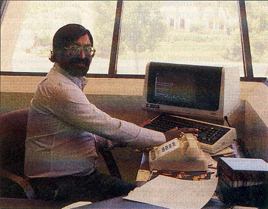
Shiraz was born in 1947 in Tanzania, East Africa. His native language is Swahili. He lived with his parents in Tanzania until he successfully completed his school-leaving examinations. He then applied to study electrical engineering at the University of Southampton. This university is on England’s west coast and enjoys an excellent reputation in Europe. Shiraz was accepted, but after only a short time he went to America.
He continued his studies from 1969 to 1973 at Stanford University in Palo Alto, an elite institution for electronics specialists. Stanford soon recognized what an inventive mind Shiraz had. He was recruited to take part in a research project dealing with rocket stability problems. He completed his studies with flying colors.
After graduating, Shiraz had had enough of rockets for the time being and decided to turn his attention more toward computers. He went to Commodore. At the time, neither he nor his friends realized how far-reaching that decision would prove to be. That job opened the door to his real career.
As a young engineer, he worked in the microprocessor research department. Commodore was making pocket calculators at the time. These calculators already boasted an impressive 64 bits. Their CPUs, however, were relatively slow and processed one task at a time. Sixty-four-bit registers may sound impressive, but their computing speed was far below that of today’s processors.
Nevertheless, Shiraz describes this as one of the most important periods of his life. Working so closely with microprocessor technology made him realize what capabilities lay hidden in such a tiny device, and that its development was still in its infancy.
But what attracts him to a computer? What is the fascination that draws him to these machines? Shiraz expresses it in a short but telling sentence:
“Achieving so much with so little. What a computer can do is only a secondary consideration. More important is how few resources it needs to do it. Developing a chip that does as much as two chips did before is a good engineering achievement.
“But integrating that new chip into a system in which even the smallest change determines whether it works or not — that demands more. Computers with the capabilities of the Atari ST have existed for a long time. Until now, however, nobody has been able to offer a computer with these features that consists of so few components.
“For these reasons, one thing is especially important: anyone getting into computer technology should start at the very bottom. That does not mean sweeping the workshop — although that is sometimes necessary too — but working with the smallest unit. The smallest and also the most important unit is the microprocessor.”
Shiraz says: “Only those who really understand what goes on in this world of tiny things, and what resources lie dormant there, can build good computers.”
He has many role models in this respect, including Steve Wozniak, one of Apple’s two founders. Before starting his company, Wozniak also worked in processor development at Hewlett-Packard. Shiraz says: “For a hardware hobbyist, working with small computers is far more useful than working with a giant computer.”
Every computer consists of many individual solutions linked together like the links of a chain. A chain is only as strong as its weakest link. A fast computer, for example, is held back by a slow floppy-disk interface. Every change to a detail therefore affects the whole system.
When making changes, Shiraz consequently advises keeping a critical eye on the entire computer system, rather than just parts of it. Even the smallest change always affects the whole system. “Look at the forest, not just the tree,” he says by way of illustration.
In Shiraz’s opinion, the 68000 is particularly well suited to getting familiar with a microprocessor. He stresses that he does not mean this as an advertisement for the Atari ST; it is simply his conviction.
Another kind of preparation for entering the profession helped him a great deal. Many universities have working groups, and Shiraz took part in such groups at Stanford. This later even led to a major research contract. You should not expect a financial windfall, but you will already have practical experience to show when looking for a job.
Shiraz says: “As in many other professions, computer manufacturers like people with practical experience. The bookworm has little chance in the United States. Circuits always work on the schematic, but when you build them, faults emerge. That is why practical experience is in demand.”
Shiraz advises throwing yourself into your work with plenty of personal commitment. He is convinced that this provides the best foundation for success in your future career. And he should know!
Original and related reading
Read the German original: “Mit so wenig so viel erreichen” →
Continue with Shivji’s career and the creation of the Atari ST, or explore the development of TOS and GEM.